
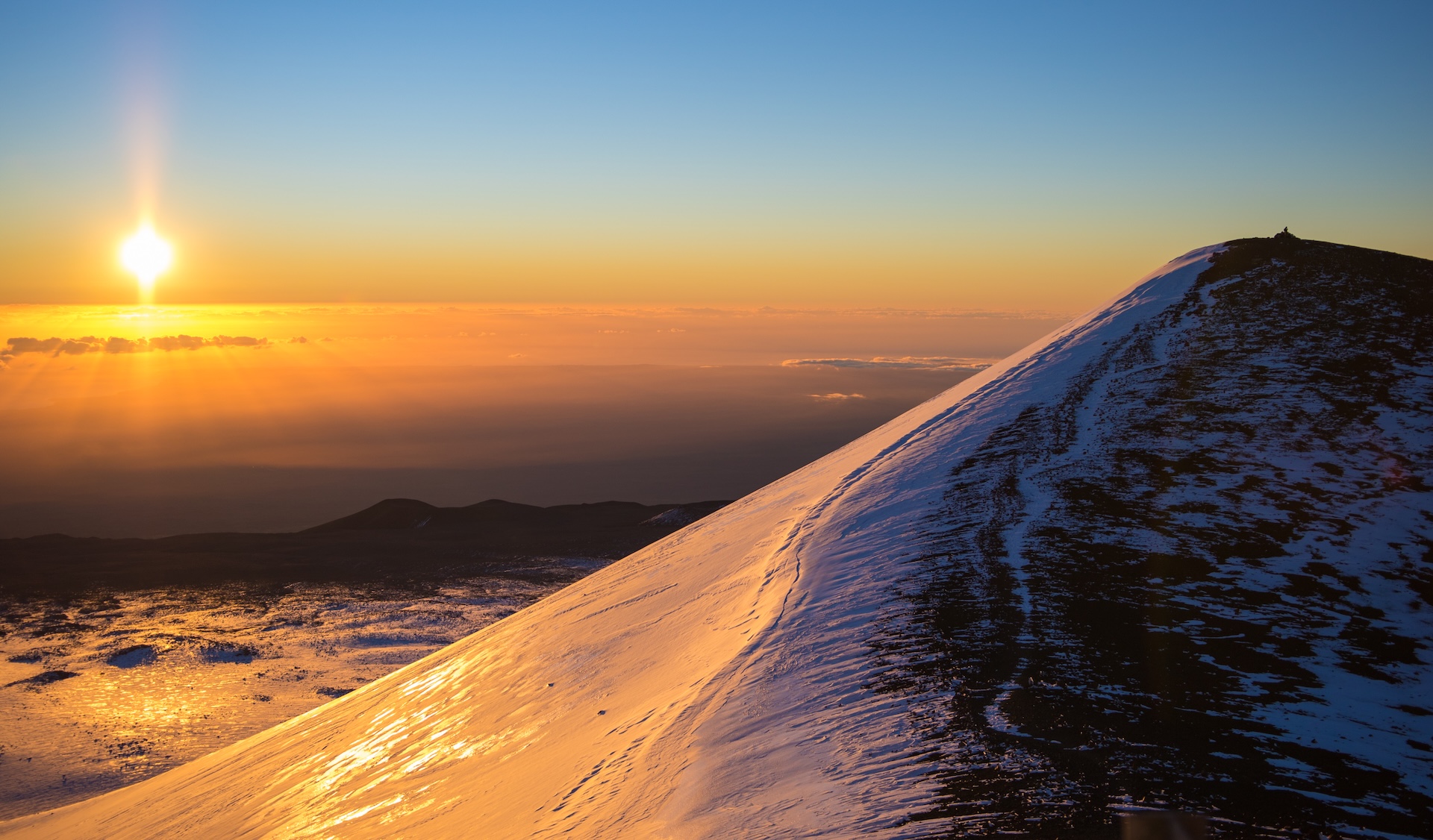
Choosing between Mauna Kea's summit on the Big Island and Haleakalā's summit on Maui for a sunset experience requires understanding their unique characteristics. Both are iconic for their clear skies and high elevations, promising unforgettable vistas. However, the journey, the views, and the overall atmosphere differ significantly.
For those drawn to the Big Island, Mauna Kea offers a direct ascent into astronomical history. It's an undisputed world leader in ground-based astronomy, with an array of cutting-edge telescopes gracing its summit. Haleakalā, on Maui, provides a similarly mesmerizing experience but with a distinct, often more accessible, geological narrative.
The Journey to the Summit: Access and Ascent
Mauna Kea's Demanding Heights
Reaching the summit of Mauna Kea, nearly 13,800 feet above sea level, is an adventure. The paved road transitions to an unpaved, steep, and winding section after 9.5 miles from the Visitor Information Station (VIS) at 9,200 feet. This 4.6-mile stretch to the summit requires a 4-wheel-drive vehicle with low-range gearing and takes careful navigation. Most rental car agreements prohibit driving to the summit, making a private tour in a suitable vehicle the most responsible — and often only — option. Expect total drive time from Kailua-Kona to the summit to be around 2.5 to 3 hours, and from Hilo, about 1.5 to 2 hours.
Haleakalā's Smoother Path
In contrast, the drive to Haleakalā's summit (10,023 feet) on Maui is entirely paved, following the Haleakalā Highway (Route 378). While very steep and winding in parts, it's generally manageable for most vehicles. The journey from Kahului will take approximately 1.5 to 2 hours, making it a less demanding drive logistically. However, reservations are mandatory for summit entry between 3:00 AM and 7:00 AM for sunrise; while not strictly required for sunset, arriving early is always advised.
The View at Sunset: Terrestrial vs. Astronomical
Mauna Kea: Where Earth Meets the Stars
Mauna Kea's summit offers a sunset spectacle that is unparalleled. From this vantage, you're literally above the clouds, often seeing the sun dip below a vast ocean of white before splashing vibrant colors across the sky. The horizon appears curved, emphasizing the Earth's spherical nature. As twilight deepens, the clarity of the night sky is breathtaking, revealing a staggering number of stars, nebulae, and galaxies due to minimal light pollution and dry atmospheric conditions. It's a prime location for stargazing directly after sunset. The silhouettes of the world's most powerful telescopes add an almost sci-fi element to the landscape.
Haleakalā: Craters and Cloudscapes
Haleakalā's sunset provides a similarly dramatic experience, often enhanced by the vast, lunar-like volcanic crater stretching out below. The views from the summit take in Maui's diverse landscapes, along with neighboring islands floating in the distance. The cloud formations are frequently spectacular, creating a dynamic canvas of light and shadow. While the stargazing conditions are excellent immediately after sunset, they don't quite match Mauna Kea's extreme altitude and specialized observatories for raw astronomical power. The focus here is often on the geological grandeur of the crater and the sea of clouds.
Altitude and Amenities: Preparing for the Peaks
Mauna Kea: High Altitude, Limited Services
The extreme altitude of Mauna Kea's summit demands respect. The air is thin, and visitors are strongly advised to acclimate at the VIS for at least 30 minutes before proceeding higher. There are no services, food, or restrooms past the VIS. Temperatures can drop significantly, often below freezing, even in summer. Layers of warm clothing, including hats and gloves, are essential. Anyone with respiratory or heart conditions, or who is pregnant, should consult a doctor before ascending. Children under 16 are not permitted above the VIS by many tour operators and are generally not recommended due to altitude risks.
Haleakalā: Manageable Height, Visitor Center Access
Haleakalā's 10,023-foot elevation is still significant, but generally less impactful than Mauna Kea's. The air is thin, and warm layers are crucial year-round. However, there are visitor centers at the summit and lower elevations with restrooms. The peak generally feels more accessible to a broader range of visitors. While not as cold as Mauna Kea, temperatures can still dip into the 30s and 40s Fahrenheit, especially after sunset.
Mauna Kea vs. Haleakalā: A Direct Comparison
| Feature | Mauna Kea | Haleakalā |
|---|---|---|
| Elevation | Nearly 13,800 feet (4,207 meters) | 10,023 feet (3,055 meters) |
| Vehicle Access | 4WD required past VIS, often restricted by rentals | Paved road to summit, 2WD fine but 4WD recommended for comfort |
| Stargazing | World-class, unparalleled clarity | Excellent, but slightly less extreme than Mauna Kea |
| Primary View | Above cloud deck, observatories, curvature of Earth | Vast volcanic crater, cloudscapes, neighbor islands |
| Amenities | VIS at 9,200 ft (restrooms, limited shop) | Summit Visitor Center (restrooms) |
| Typical Temps | Sub-freezing often, especially after dark | Can be in 30s-40s F, even in summer |
| Altitude Acclimation | Strongly recommended at VIS | Recommended, less critical than Mauna Kea |
| Special Considerations | 4WD vehicle and tour highly recommended, no children under 16 above VIS | Sunrise reservations mandatory, often crowded |
The High-End Hawaii Advantage
For those seeking the ultimate Big Island sunset and stargazing experience, Mauna Kea stands supreme. Navigating the unique demands of this environment calls for expert guidance. Our private Big Island tours offer a curated journey to Mauna Kea, providing the necessary 4-wheel-drive vehicles, experienced driver-guides, and all the thoughtful amenities to ensure your comfort and safety at high altitudes. We handle every detail, from the challenging drive to hot beverages and warm outer layers, allowing you to fully immerse yourselves in the awe-inspiring spectacle. Our guides offer insightful narration, sharing details about the mountain's cultural significance and astronomical importance, as outlined in our comprehensive [/guides/mauna-kea-guide].
The High-End Hawaii Take
While both Mauna Kea and Haleakalā deliver breathtaking summit sunsets, Mauna Kea's extreme elevation, demanding journey, and unmatched stargazing capabilities set it apart as a genuinely world-class astronomical destination. It's an experience of epic scale, requiring responsible planning and an appropriate vehicle. Haleakalā offers a magnificent and more accessible high-altitude experience with incredible crater views. For the discerning traveler prioritizing an immersive, unparalleled celestial event with robust support, Mauna Kea is the definitive choice. LESS CROWD. MORE WOW. Call us at +1 (808) 204-4745 to plan your Big Island adventure.
Keep going